

Solvent Recyclers & Solvent Recovery Systems
A solvent recycler, also called a solvent recovery system or solvent still, distills your dirty solvent and gives you back clean, reusable solvent right on your shop floor. You can recover 90% or more of it, and cut the solvent you buy and the hazardous waste you haul away by up to 90%. Most shops see payback in 4 to 12 months.
Solvent Recycling Systems supplies batch solvent recyclers from compact 8-gallon units to large-capacity systems, including vacuum-distillation models for high-boiling and heat-sensitive solvents. We recycle mineral spirits, naphtha, flexo and litho solvents, acetone, and most common cleaning solvents.
Keep your recycler running at full performance with our recycling bags, thermic oil, lid seals, and condensers. Not sure which recycler fits your solvent and volume? Run the ROI Calculator to see your savings, then request a quote.
-
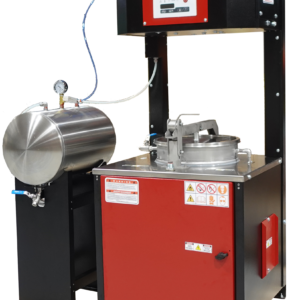
SR30V Solvent Recycler – 8 Gallon Class I Div I Solvent Reclaim System
Request a Quote -
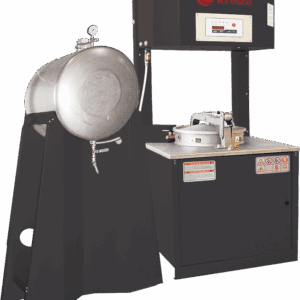
SR60V Solvent Recycler – 15 Gallon Class I Div I Solvent Reclaim System
Request a Quote -

SR120 Solvent Recycler – 30-Gallon Class I Div I Solvent Reclaim System
Request a Quote -

SR240 Solvent Recycler – 64 Gallon Class I Div I Solvent Reclaim System
Request a Quote -
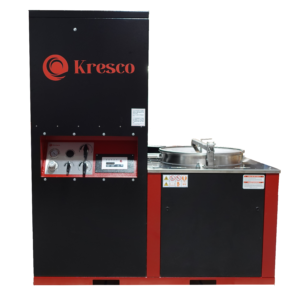
SR180 Solvent Recycler – 48 Gallon
Request a Quote -
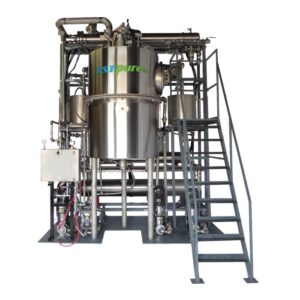
Kresco SRC Series Continuous-Flow Solvent Recyclers – 3 to 100 GPH Continuous Solvent Distillation
Request a Quote -
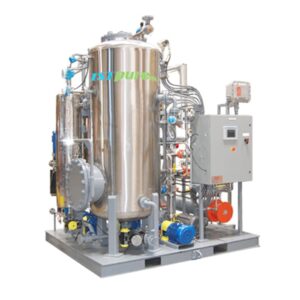
Kresco SRXC Distillation Columns
Request a Quote -

Thermic Oil for Electric-Heated Solvent Recyclers – 55 Gallon Drum
Request a Quote -

Kresco 1/2″ Air-Operated Diaphragm Pump for Solvent Recyclers – 15 GPM Solvent Transfer and Feed Pump
Request a Quote -

Replacement Fuse — 1/4A, 250V (SR30 F5)
$5.00 -
Replacement Fuse — 1/16A, 250V (SR30 F3/F4)
$20.00 -
Solvent Recycler Vacuum Gauge — 0-30 PSI
$28.80
Solvent Recycling Bags
-
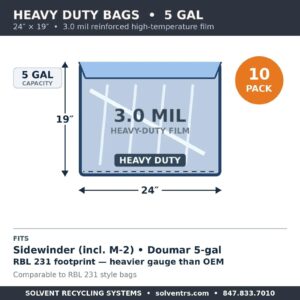
Solvent Recycler Liner Bags for Sidewinder & Doumar — 24″×19″, 3 Mil Heavy-Duty (10-Pack)
$29.00 -
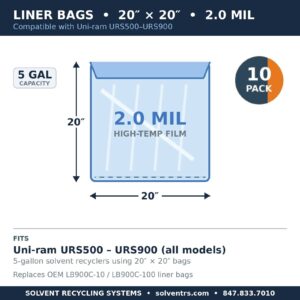
Solvent Recycler Liner Bags for Uni-ram URS500–URS900 — 20″×20″, 2 Mil (10-Pack)
$39.00 -
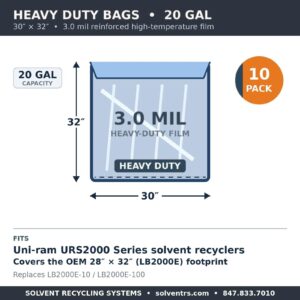
Solvent Recycler Liner Bags for Uni-ram URS2000 Series — 3 Mil Heavy-Duty (10-Pack)
$99.00 -
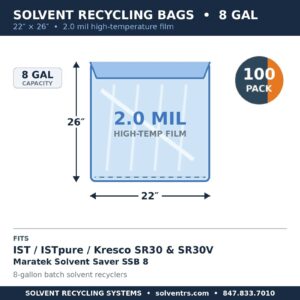
Solvent Recycler Bags for Kresco / ISTpure SR30 & 8-Gallon Recyclers — 2 Mil Standard, 100 Pack
$379.50 -
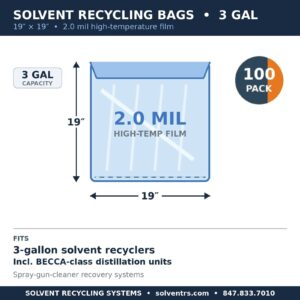
Solvent Recycling Bags 3-Gallon, 100 pack
$441.00 -
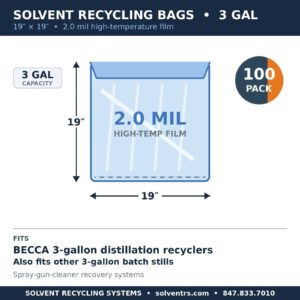
Solvent Recycler Bags for BECCA 3-Gallon Solvent Saver — 2 Mil, 100 Pack
$441.00 -
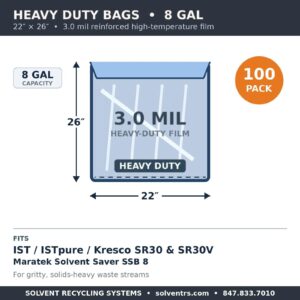
Solvent Recycler Bags for Kresco / ISTpure SR30 & 8-Gallon Recyclers — 3 Mil Heavy Duty, 100 Pack
$518.00 -
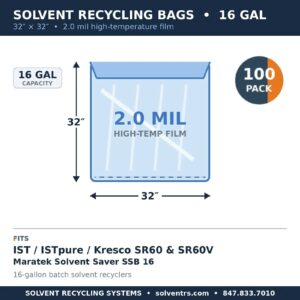
Solvent Recycler Bags for Kresco / ISTpure SR60 & 16-Gallon Recyclers — 2 Mil Standard, 100 Pack
$621.00 -
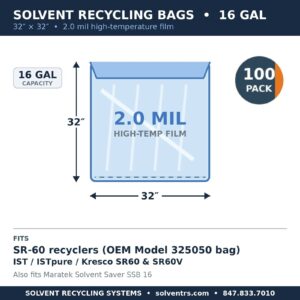
SR-60 (Model 325050) Solvent Recycling Bags — 2 Mil, 100 Pack
$621.00 -
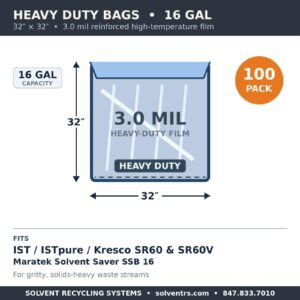
Solvent Recycler Bags for Kresco / ISTpure SR60 & 16-Gallon Recyclers — 3 Mil Heavy Duty, 100 Pack
$834.00 -
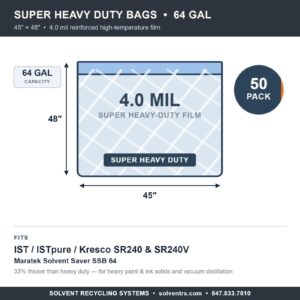
Solvent Recycler Bags for Kresco / ISTpure SR240 & SR240V — 4 Mil Super Heavy Duty, 64-Gallon, 50 Pack
$1,349.00 -
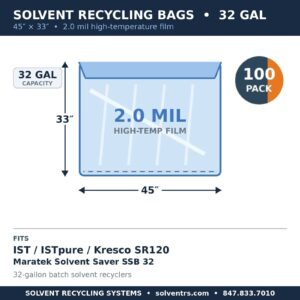
Solvent Recycler Bags for Kresco / ISTpure SR120 & 32-Gallon Recyclers — 2 Mil Standard, 100 Pack
$1,552.50
How solvent recovery works
Dirty solvent goes into the boiler, usually inside a disposable recycling bag. The unit heats it past the solvent’s boiling point. The vapor rises to a condenser, cools back into clean liquid, and drains into a container ready for reuse. Paint, ink, resin and oil stay behind in the bag as dry or semi-dry residue. A PLC runs the whole cycle, so operators load it, start it and walk away. Vacuum-distillation models lower the boiling point to handle high-boiling and heat-sensitive solvents safely.
What solvents can you recycle?
Mineral spirits and parts washer solvent, acetone, lacquer thinner, naphtha, flexo and litho press-wash solvents, alcohols including ethanol and IPA, xylene and toluene, MEK, and most common gun-wash and cleanup solvents. See Recyclable Solvents for the full list, or send us your SDS and we’ll confirm.
Sizing a solvent recovery system
Match the boiler to how much dirty solvent you generate per shift:
- Up to about 8 gal/day: SR30V (8 gal)
- 8–15 gal/day: SR60V (15 gal)
- 15–30 gal/day: SR120 (30 gal)
- 30–64 gal/day: SR180 (48 gal) or SR240 (64 gal)
- Continuous production lines: SRC continuous-flow units (3–100 GPH) and SRXC distillation columns
Our free sizing guide and ROI calculator walk through the math.
Who uses solvent recyclers
Flexographic printers, paint booths and finishing lines, cabinet and wood flooring manufacturers, boat builders, metal fabrication shops, extraction labs, and anyone running a solvent parts washer or spray gun washer.
Solvent recycler FAQs
Is a solvent recycler worth it?
If you buy or dispose of more than a few drums of solvent a year, usually yes. Most shops see payback in 4 to 12 months.
Is it safe to distill flammable solvent on site?
Our recyclers are certified to UL 2208 and CSA C22.2 No. 30 for Class I, Div 1, Group D hazardous locations and meet NFPA 30, 33 and 70.
What’s the difference between a solvent recycler and a solvent recovery system?
They are the same thing. Both use distillation to separate clean solvent from paint, ink, resin, oil and other contaminants.
What do I do with the residue?
It stays in the recycling bag and is disposed of as a small, concentrated waste, a fraction of the volume you would otherwise haul away.
How much maintenance does a solvent recycler need?
About a 4-hour maintenance routine every 2,000 hours of operation.

Solvent Recyclers Eliminate Waste, Save Money
Our on-site distillation systems provide a cost-effective solution for safely recycling solvents and other hazardous chemicals from industrial processes.
Our systems are easy-to-use, require low maintenance and will significantly reduce your solvent purchasing and hazardous waste disposal costs.
Guaranteed
Backed up by industry’s leading 2-year manufacturer warranty.
Cost-effective
Most of our clients have achieved a return on investment (ROI) in as little as 4 to 12 months.
Durable
Built with robust, corrosion-free stainless-steel tanks.
Fully Automated Process
Operate on a fully automated process assisted by a PLC with predetermined parameter settings and built-in alarm signals.
Virtually Maintenance-Free
Requires low maintenance and supervision, a simple 4-hour maintenance routine every 2,000 hours of operation.
Certified in North America
Certified to UL standard 2208 and CSA C22.2 No. 30 in Canada and the U.S. for class I, Div.1, Group D hazardous locations, and meets NFPA codes 30, 33, 70.
