

If you’re pricing out your first blast room, you’ve probably discovered that nobody publishes a price list. That’s not a sales trick — a blast room is an engineered system, and two rooms with the same footprint can differ in cost by six figures depending on what’s under the floor. This guide walks through the decisions that actually drive a blast room project: size, media recovery, dust collection, and the operational details that determine whether the room pays for itself.
Start With the Parts, Not the Room
The right way to size a blast room is to list the largest parts you blast today, the largest you expect in five years, and how they move: forklift, crane, cart, or drive-in. Add working clearance around the part — an operator needs room to hold a blast nozzle at the correct angle and distance on every surface. Modular galvanized-steel panel construction means the enclosure itself can be built to nearly any dimension, from a single-operator room to a drive-through bay for trailers and structural steel, so the enclosure size should follow your parts list, not a catalog page.
Media Recovery: the Biggest Cost (and Productivity) Decision
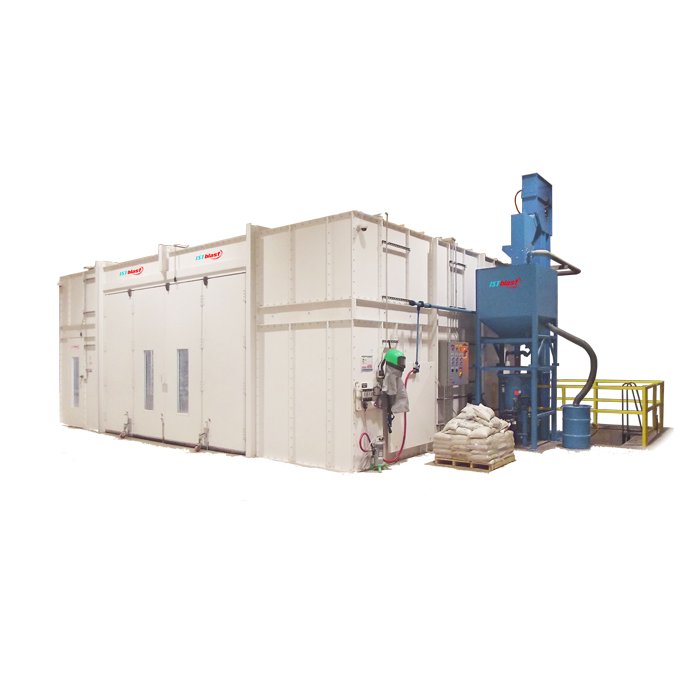
When a blast room quote surprises people, the floor is usually why. Spent abrasive has to get back to the blast pot somehow, and there are three ways to do it:
- Sweep-in / shovel recovery. Cheapest to install — operators sweep media to a recovery point. The hidden cost is labor: in a busy room, sweeping can consume 20–30% of an operator’s day, and it’s the first corner that gets cut on a Friday afternoon.
- Pneumatic recovery floors (e.g. Kresco PARS2000). Air-driven floor sections carry media back automatically. Cost-effective, available in partial-floor configurations, and typically installable without deep excavation — a strong choice for retrofits and mid-volume shops.
- Mechanical screw-conveyor floors (e.g. Kresco MARS2000). The heavy-duty option: robust conveyors under the floor that handle any media type and heavy contaminant loads continuously. Usually needs a shallow pit, and it’s the standard answer for high-volume, multi-shift operations. Hybrid systems (HARS2000) combine both approaches.
A useful rule of thumb: the more hours per day the room runs, the faster an automated recovery floor pays back against sweeping labor — and recovered, recycled media (steel grit, aluminum oxide, garnet) cuts abrasive spend dramatically versus blast-and-discard.
Dust Collection Is Not Optional
Visibility inside the room and air quality outside it both depend on the dust collector. A properly sized reverse-pulse cartridge collector pulls a steady airflow through the room, captures 99.9% of particles 5 µm and smaller, and cleans its own cartridges automatically so performance doesn’t fade mid-shift. Undersized dust collection is the most common defect we see in older rooms: the operator ends up blasting blind, quality drops, and housekeeping becomes a daily fight.
The Details That Separate a Good Room From a Cheap Box
- Lighting — high-lumen LED bays (18,000 lumens) positioned so the operator isn’t working in their own shadow.
- Doors — bifold, trifold, or rubber roll-up doors matched to your floor plan; drive-through doors on both ends where flow matters.
- Operator safety — personnel doors with observation windows, door interlocks, emergency stops, and supplied-air respirators with air filtration and gas detection.
- Controls — PLC with a touch-screen HMI that flags maintenance before it becomes downtime.
- Wear protection — rubber interior lining where ricochet is heaviest.
- Part handling — overhead monorails and removable flooring for very heavy parts.
So What Does a Blast Room Cost?
The honest answer: the enclosure is the smaller share of the project — media recovery, dust collection, and blasting equipment drive most of the budget, and site factors (pit or no pit, compressed air capacity, electrical) move it further. That’s why credible suppliers quote from your part sizes and duty cycle instead of publishing prices. Bring us those two things and we’ll give you a realistic budgetary range for a turnkey Kresco blast room — designed, manufactured, installed, and supported, with over 1,000 installations across North America behind it.
One More Thing: Plan for Flash Rust
Freshly blasted steel starts flash-rusting within hours. If parts won’t be coated the same day, build corrosion protection into the process — as a Cortec distributor we routinely pair blast rooms with VpCI rust preventatives and VCI packaging so the surface prep you paid for survives until paint.
Ready to spec a room? Request a free process evaluation — tell us your parts, media, and throughput and we’ll recommend the room size, recovery floor, and dust collector that fit.
