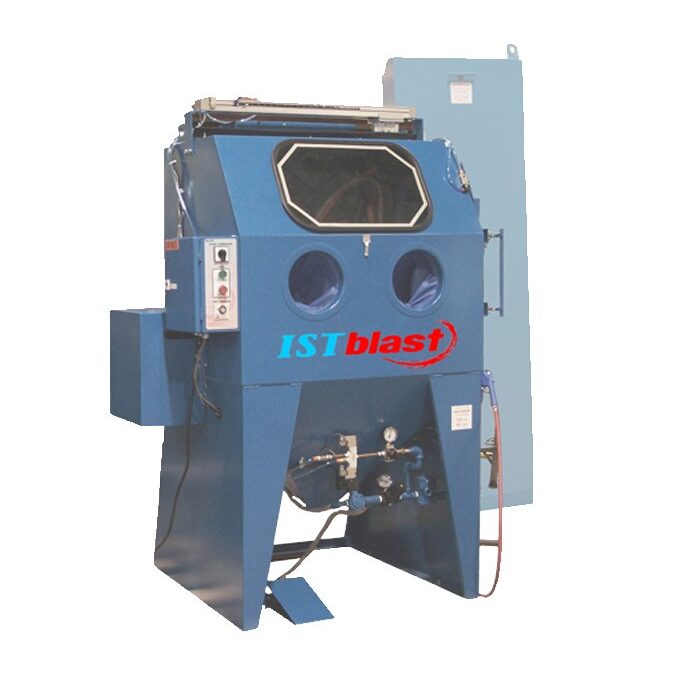
Most abrasive blasting moves the part past a fixed nozzle. Industrial sandblasting robots do the opposite — the part stays put and a robotic arm carries the blast gun around it on a programmed path, holding standoff distance, impingement angle, and dwell time...
Every blast room lives or dies by one question: how does the abrasive get back to the pot? The recovery system is the single biggest driver of a blast room’s cost, its floor construction, and how many productive blasting hours you get per shift. Here’s how...
If you’re pricing out your first blast room, you’ve probably discovered that nobody publishes a price list. That’s not a sales trick — a blast room is an engineered system, and two rooms with the same footprint can differ in cost by six figures...
If your press operators are bumping ink to hit density targets, the problem usually isn’t the ink — it’s the anilox. Every hour of production drives ink and coating residue deeper into engraved cells. Cell volume (BCM) quietly drops, ink transfer falls...
Most shops buy finishing equipment one piece at a time — a blast cabinet this year, a spray gun washer the next, a solvent recycler when disposal costs get painful. But blasting, painting, and cleanup aren’t separate purchases. They’re one connected line,...
When parts are too big for a cabinet — structural steel, tanks, rail, heavy fabrications — you blast them in a walk-in blast room. But the room itself is only half the system. The other half, and where the economics really live, is media recovery: how quickly and how...