

Every blast room lives or dies by one question: how does the abrasive get back to the pot? The recovery system is the single biggest driver of a blast room’s cost, its floor construction, and how many productive blasting hours you get per shift. Here’s how the main options compare, using Kresco’s recovery lineup as the reference points.
Manual Sweep Recovery: Low Cost, High Labor
In a sweep-in room, media piles up on a flat floor and operators push it to a collection hopper. Installation cost is minimal — but a working blast room generates a surprising amount of spent media, and every minute spent sweeping is a minute not blasting. Sweep recovery makes sense for occasional-use rooms; in daily production it quietly becomes the most expensive “cheap” option in the shop.
Pneumatic Recovery (PARS2000): the Retrofit-Friendly Workhorse
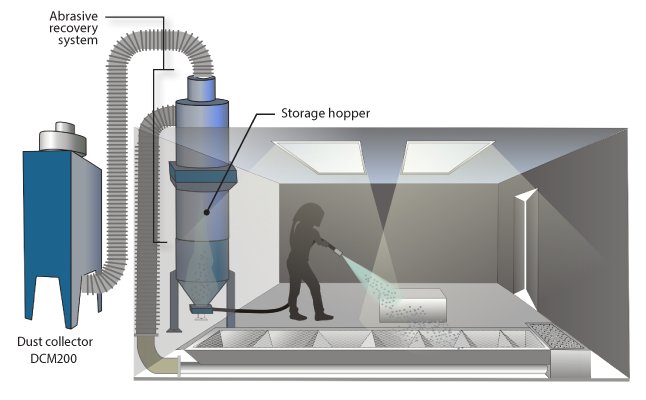
Pneumatic recovery floors use air to convey spent media from floor sections back to the reclaim system. The practical advantages are big: multiple floor configurations (full coverage or partial strips), shallow construction that usually avoids deep excavation, and a cost point well below full mechanical floors. For most job shops and mid-volume operations, a pneumatic floor is the sweet spot. A related option, the PARS5000 vacuum recovery head, handles media recovery from confined spaces and tank interiors.
Mechanical Recovery (MARS2000): Built for Tonnage
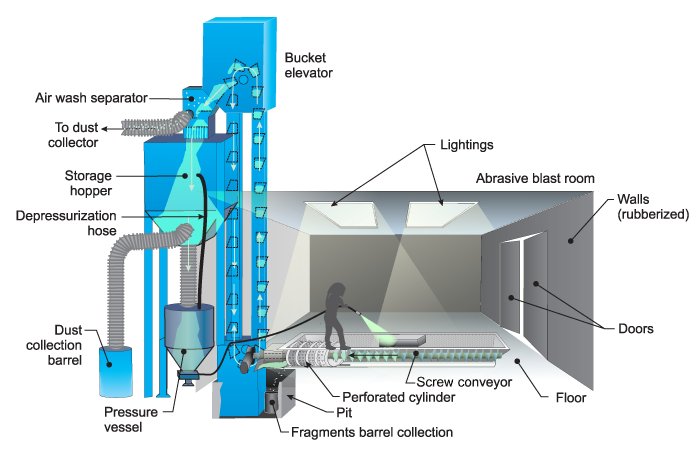
Mechanical recovery uses screw conveyors beneath the floor to move media continuously to the reclaim and cleaning system. It’s the most robust option — it handles every media type, shrugs off heavy contaminant loads (scale, rust, old coatings), and keeps up with multi-operator, multi-shift production. The trade-offs are a shallow pit requirement and a higher initial investment that high-volume operations recover quickly in labor and media savings.
Hybrid Recovery (HARS2000): Both Where It Counts
Hybrid systems combine a mechanical spine with pneumatic sections — mechanical durability in the high-traffic center of the floor, pneumatic flexibility at the edges. Heavy-duty facilities choose hybrids to get near-full-floor automatic recovery without the cost of a wall-to-wall mechanical floor.
No Pit? No Problem
Retrofitting a blast room into an existing building where excavation isn’t feasible is common. Above-floor mechanical loading recovery systems and shallow pneumatic floors are designed for exactly this — you give up a few inches of working height instead of cutting concrete.
Don’t Forget the Other Half: Media Cleaning and Dust Collection
Recovery only pays off if the media comes back clean. The reclaim system separates good media from fines, debris, and dust, returning blast-ready abrasive to the pressure pot while the fines go to a reverse-pulse cartridge dust collector (99.9% capture at 5 µm). Matched recovery + reclaim + dust collection is what lets recyclable media like steel grit run dozens of cycles — which is where a blast room’s operating-cost advantage really comes from.
Quick Comparison
| Recovery type | Install cost | Labor | Excavation | Best fit |
|---|---|---|---|---|
| Sweep-in | Lowest | High | None | Occasional use |
| Pneumatic (PARS2000) | Moderate | Low | Minimal | Job shops, retrofits, mid-volume |
| Mechanical (MARS2000) | Higher | Lowest | Shallow pit | High-volume, heavy contaminants |
| Hybrid (HARS2000) | High | Lowest | Partial | Heavy-duty facilities |
| Mechanical loading (above-floor) | Moderate | Low | None | Oversized rooms, no-dig sites |
Not sure which floor fits your operation? That’s the core of the free process evaluation we run on every blast room project — send us your media type, part mix, and hours of blasting per day, and we’ll spec the recovery system with the numbers to back it up.
