

If your press operators are bumping ink to hit density targets, the problem usually isn’t the ink — it’s the anilox. Every hour of production drives ink and coating residue deeper into engraved cells. Cell volume (BCM) quietly drops, ink transfer falls with it, and color consistency becomes a moving target. This guide covers how anilox rolls get cleaned, why dry-media cabinet systems have become the go-to for flexo shops that clean in-house, and how to pick the right setup for your press.
Why Anilox Cells Plug — and Why It Costs You
An anilox roll is a metering device: its engraved cells carry a precise volume of ink to the plate. When dried ink, UV coatings, or adhesives build up in those cells, effective volume drops — often 10–30% before anyone notices. The symptoms show up on press as inconsistent density, dirty print, mottle, and jobs that need “just a little more ink” every month. You end up compensating with ink, time, and waste for a problem that lives in the cells.
The Main Ways to Clean an Anilox Roll
Manual scrubbing with brushes and chemistry is cheap but slow, inconsistent, and hard on operators — and it rarely restores deep cell volume. Chemical soaking can work but creates a spent-chemistry disposal problem and risks damaging cell walls if dwell times run long. Ultrasonic cleaning is effective when run correctly but requires careful control on fine line-count ceramic rolls. Dry-media blast cleaning — the method used in the AC series systems we supply — removes dried residue with a soft blast media that reaches the bottom of the cell without attacking the ceramic or chrome surface, and it does it in minutes with no chemistry and no wastewater.
How a Dry-Media Anilox Cleaning Cabinet Works
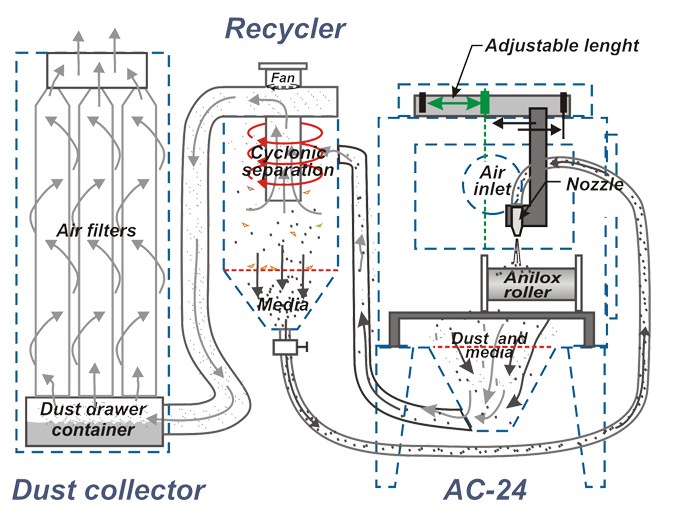
The roll rotates on powered supports inside the cabinet while a nozzle with adjustable stroke length traverses the full engraved face — every band of the roll gets uniform coverage. Spent media and released ink dust drop into a hopper, where a cyclonic recycler separates reusable media from fines: clean media returns to the nozzle, and dust is captured in a cartridge dust collector. The loop is closed. There’s no rinse water to treat, no chemical bath to manifest, and the roll comes out ready to measure and mount.
Cabinet or Tub? Sizing to Your Press
For narrow-web label and flexible packaging shops, the AC24 and AC36 cleaning cabinets handle rolls up to 24″ and 36″ respectively — compact enough to live next to the press. Wide-web and corrugated operations running big face widths need the AC40–AC160 cleaning tubs, sized for rolls from 40″ all the way to 160″. Either way, the payoff is the same: cleaning between jobs instead of shipping rolls out or saving deep cleans for a lost weekend.
The Other Half of the Closed Loop: Your Wash-Up Solvent
Most flexo pressrooms that clean aniloxes in-house are also washing ink pans, doctor blade chambers, and press parts with solvent every shift. That dirty solvent doesn’t have to leave the building either. A solvent recycler distills contaminated wash-up solvent back to clean, reusable solvent on site — typically recovering 97%+ and cutting hazardous waste hauls by up to 90%. Between dry anilox cleaning and on-site solvent recovery, a pressroom can close the loop on its two biggest cleaning headaches at once.
Want numbers for your shop? Tell us your roll sizes and line counts and we’ll recommend the right AC system and media — request a quote or try our solvent recycling ROI calculator.
The rest of the cleanup problem
The anilox is one stage of four. Press wash solvent, ink pans and doctor blade chambers, and rust on stored press components all cost money in the same operation. See how the whole cycle fits together on our page for flexographic printers.
