
Description
VpCI®-422 is a 92 % biobased organic rust and tarnish remover that strips rust off steel, iron, copper and brass and is far more operator-friendly than a mineral acid. It is NSF A3 registered and passes hydrogen embrittlement standards, which matters on fasteners and high-strength steel. VpCI-422 is a USDA Certified Biobased Product with 92% biobased content. The 55-gallon drum is used at full concentrate and is the format for a production derusting tank or a spare-parts preservation program that runs every week.
VpCI-422 replaces mineral-acid pickling and rust-removal baths in the maintenance shop and on the production floor. Its organic chemistry lifts rust, tarnish and scale from ferrous and non-ferrous metals without attacking the base metal, and because it carries VpCI inhibitors it is not aggressive to the substrate and will not harm skin, most paints, plastics or rubber. It is completely organic, readily biodegradable, non-flammable and 92 % biobased by ASTM D6866, and its hydrogen-embrittlement test results make it usable on fasteners, springs and high-strength steel where an acid dip is a liability. In the Cortec Product Consultation Guide VpCI-422 is approved for carbon steel, stainless steel, cast iron, galvanized steel, copper, brass and solder; it is not rated for aluminum, where VpCI-426 is the correct product. Derusted steel flash rusts quickly, so Cortec pairs VpCI-422 with a VpCI cleaner as a neutralizing and protecting step.
Typical applications
- In-process rust removal for parts and metal stock
- Interior and exterior surfaces of tanks and vessels
- Outdoor machinery and equipment
- Fences, railings and walls
- Tools, locks and rust-frozen parts
- Dip-tank derusting of spare parts, gears and machined components before preservation
- Salvaging rusted inventory and returned goods instead of scrapping them
- Removing rust stains from concrete floors and structures
How to apply VpCI-422
- Set up three stations. A tank of VpCI-422 at full concentrate large enough to submerge the part; a water rinse tank; and a 5 to 10 % VpCI cleaner tank (VpCI-414, 415 or 416 for dip, VpCI-418 LM for spray). Fit the 422 tank with a screen or pump and filter to remove metal fines.
- Pre-clean. Remove excess grease, debris and loose flaky rust with a rag, pressure wash or wire brush.
- Soak. Submerge the part, or spray and keep the surface wet; do not let it dry on the part. Wrap parts in clear stretch film on long soaks and keep the tank covered when idle.
-
Rust Approximate soak time Light 15 minutes Medium 30 minutes Heavy 1 hour or more Heating the bath up to 150 °F (65 °C) or agitating the part speeds removal.
- Drain and rinse. Lift the part, let excess drain back into the tank, and dip it in the water rinse so no VpCI-422 is carried into the cleaner.
- Neutralize and protect. Dip briefly in the VpCI cleaner solution (or spray with VpCI-418 LM), set the part on a clean surface and let it air dry. The transparent dry film prevents flash rust; the part can be used immediately or given a VpCI rust preventative, coating or VpCI packaging for longer storage.
- On concrete. Apply at 200 to 600 sq ft per gallon (5 to 15 m² per liter) to remove rust stains, then rinse and neutralize with MCI-2060.
- Bath life and storage. Add fresh product to extend the bath as it loads with iron. Non-flammable; store at room temperature and keep from freezing.
Compatibility
Cortec’s elastomer testing rates VpCI-422 fully compatible at 100 % concentration with EPDM, Viton (FKM), PTFE, nylon, PET, acetal and fiberglass. Nitrile (Buna-N) is rated not compatible, so use EPDM or Viton gloves and seals and a polyethylene, polypropylene or fiberglass tank. It will not harm most paints, plastics or rubber, but test any finish you want to keep. See the full oil and elastomer compatibility charts.
Where it fits in the Cortec line
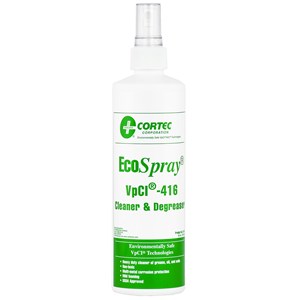
VpCI-422 is the liquid workhorse of Cortec’s organic rust removers. VpCI-423 is the same chemistry as a gel that clings to vertical and overhead surfaces; VpCI-426 is the stronger rust and scale remover that is also rated for aluminum and brightens copper; VpCI-429 is the pH-neutral chelating remover that needs no neutralizing step. The neutralizing partner is a VpCI cleaner: VpCI-416 for the longest post-clean protection, VpCI-414 for the strongest cleaning, or VpCI-418 LM where the cleaner is sprayed. The derust and neutralize steps both run well in the immersion and spray stages of Build-All and Magido aqueous parts washers, and for equipment that cannot be derusted, CorrVerter rust converter primer is the alternative. For spot work there is EcoAir VpCI-422 in a compressed-air can. See the full rust prevention range for what comes after.
Field notes
A Racine, Wisconsin gear manufacturer used to blast or send out spare parts that had rusted in storage, delaying shipments by days. Now rusty parts are submerged in VpCI-422 for up to 20 minutes, rinsed, dipped immediately in VpCI-415, air-dried and shipped the same day; stock was later moved into VpCI-126 bags with BioPads so it no longer needs de-rusting. (Cortec Case History #489)
An Oklahoma waste-to-energy plant had 364 spare boiler tubes, bundled in twelves, unusable from internal rust after years outdoors. Each bundle was connected in series to a VpCI-422 circuit of tank, pump and hoses: circulate 30 minutes, soak 30 minutes, circulate and filter back, then a VpCI-418 LM circuit for a 30-minute rinse and neutralization. Two weeks for the whole job, and the tubes went into service. (Cortec Case History #835)
A Virginia gantry-crane gearbox rusty inside was restored without disassembly: filled with VpCI-422, soaked 20 minutes and rotated 5 minutes, three times; drained and filled with 1:1 VpCI-414 and water, rotated 30 minutes and drained; a borescope confirmed the rust was gone; then filled with oil plus M-531 and run 5 minutes at low speed. Two years of preservation. (Cortec Case History #828)
Specifications
| pH | 1.7–2.5 neat (VpCI-422); 6–8 for the near-neutral VpCI-422 G grade |
|---|---|
| Non-volatile content | 27–33% (VpCI-422 G: 27–35%) |
| Weight per gallon | 9.3–9.6 lb (1.11–1.15 kg/L) |
| Registration | NSF A3 registered for use in food processing areas |
| Testing | Passes ASTM F-519 mechanical hydrogen embrittlement evaluation (no embrittlement); OECD 301D easily biodegradable |
| Chemistry | Completely organic, readily biodegradable, non-flammable |
| Use | Rinse with water after use |
| Application | Dip or spray at full concentrate; brush on with VpCI-423 gel where a liquid runs off |
| Soak time | Let stand 10–15 minutes for light rust; longer for medium and heavy rust, or soak in a tank as long as required |
| Bath temperature | Ambient; heating up to 150 °F (65 °C) and agitation speed cleaning |
| Neutralize | Rinse, then dip in 5–10 % VpCI-414, 415 or 416, or spray 5–10 % VpCI-418 LM |
| Coverage (concrete rust stains) | 200–600 sq ft/gal (5–15 m²/L); neutralize with MCI-2060 |
| Metals | Steel, iron, copper, brass; for galvanized steel use the VpCI-422 G grade |
| Not recommended | Aluminum (use VpCI-426) |
| Consultation guide | Safe to use on all listed metals except aluminum |
| Elastomers | Compatible with EPDM, Viton, PTFE, nylon, PET, acetal, fiberglass; not compatible with nitrile |
| Safety | Not aggressive to base metal; will not harm skin, most paints, plastics or rubber |
| Shelf life | 2 years |
| Storage | Original packaging, indoors, out of direct sunlight, 40–100 °F (4–38 °C) |
| USDA Certified Biobased Product | Yes — 92% biobased content (USDA BioPreferred Program) |
| Size | 55 Gallon Drum |
| Shipping weight | 541 lb (245 kg) |
| Availability | In stock |
| Cortec product number | 11600104 |
Solvent Recycling Systems is an authorized Cortec® distributor. See the full Cortec VpCI line, browse the VpCI product selection guide, or contact us for volume pricing and lead times.

Reviews
There are no reviews yet.