

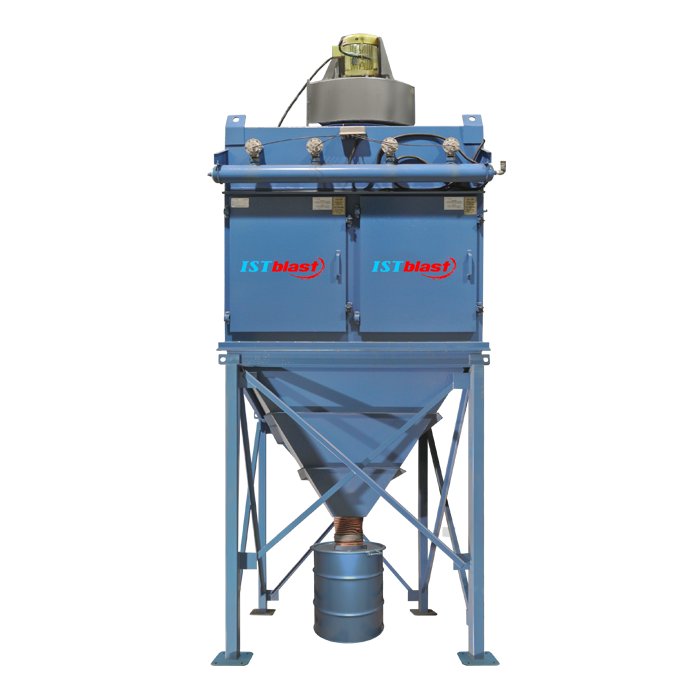
Description
The Kresco CDC Series blast room dust collectors (CDC2000 through CDC150000) are vertical cartridge collectors built for permanent sandblasting facilities: blast rooms, sandblast booths and shot-blast enclosures from a single-operator room up to a railcar or truck-body booth. From 4 cartridges and 2,000 CFM to 224 cartridges and 150,000 CFM, with self-cleaning reverse-pulse filtration that captures 99% of particles down to 1 micron and continuous operation while the filters clean themselves.
This is the dust collection behind every Kresco blast room we install. It can also be retrofitted to an existing blast room when the old baghouse or undersized collector is the reason visibility is poor, media is dirty and the room is out of compliance.
Request a quote or call (847) 833-7010. Send room dimensions (L×W×H), number of blasters, abrasive type and whether exhaust air is vented outside or recirculated — we’ll size the CFM, cartridge count and any NFPA accessories you need.
How It Works
- Dust-laden air leaves the room through the outlet plenums and enters the collector’s hopper section through a side inlet (under vacuum or pressure depending on the configuration; bin-vent models take air from the bottom).
- A hybrid inlet baffle drops the heavy fraction into the hopper; the remaining air passes through vertically mounted cartridges and particulate collects on the surface as a “dust cake.”
- Clean air exits through the plenum to atmosphere or back into the building.
- A PLC watches the pressure differential across the cartridges and fires compressed-air pulses through the 1½” Goyen valves to knock the cake off — without shutting the blower down. Dust falls to the hopper and out through a drum kit or rotary airlock.
Why Vertical Cartridges
Horizontally mounted cartridges load unevenly — the top of each filter does most of the work and operators have to rotate them. Kresco mounts cartridges vertically so the entire 36″ filter surface stays active, pulse cleaning releases dust straight down into the hopper, and the collector holds a continuous 100% filtration rate between cartridge changes. Cartridges are changed from outside the collector through tool-free doors with a manual cam-lock, so maintenance staff never climb into the dirty side.
Standard Features
- 7- to 12-gauge galvanized panel construction, all-welded hoppers, lifting lugs, adjustable-height legs
- Goyen solenoid block with 1½” Goyen diaphragm valves; PLC-controlled pulse cleaning
- Pressure-differential gauge between the clean and dirty sides (Kresco DCT1000 controller)
- Manual cam cartridge compression — no tools required for filter changes
- Belt- or direct-drive blowers; available in 240 V, 480 V and 600 V
- Kresco MERV 11 pleated cartridge media (cellulose/polyester blend); MERV 15 nanofiber flame-retardant cartridges optional
- Optional: HEPA after-filter (99.7% at 0.3 µm), horizontal or vertical muffler to meet OSHA noise limits, service ladder and platform
Fire and Explosion Prevention (NFPA)
Sand, garnet and steel grit are not explosive on their own, but the dust you pull off the part can be: aluminum, magnesium, zinc, old paint, powder coat and organics all carry a KSt value. If a dust test says your stream is combustible, the collector has to be protected to NFPA 652, NFPA 68 and NFPA 69. Kresco builds the CDC Series with the full accessory set:
- Explosion relief vents or flameless vents for collectors located indoors
- Passive isolation valve (ATEX-certified) or high-speed isolation valves on the inlet duct
- Blow-back damper that seals the intake ductwork so pressure and flame cannot return to the building
- Abort damper tied to spark detection that dumps exhaust to atmosphere the moment a spark is seen
- Spark detection and fire-extinguishing system with high-temperature probe and alarm
- Rotary airlock on the hopper discharge, broken-bag detector, explosion-proof motor, grounding kit, silencer
Which combination you need depends on where the collector sits (outside in a clear zone, inside and vented through the wall, inside with flameless venting, or inside with chemical suppression). We walk through that with you during sizing — see our guide to combustible dust and NFPA protection for blast room dust collectors.
Technical Specifications
Cartridge counts ending in D are dual-hopper units; T are triple-hopper. Filtration area is with standard 36″ Kresco cartridges.
| Model (CFM) | Valves | Hoppers | Cartridges | Filter area (sq ft) | Depth | Width | Height | Weight (lb) |
|---|---|---|---|---|---|---|---|---|
| CDC2000 | 2 | 1 | 4 | 1,260 | 2′-8″ | 3′-4″ | 12′-8″ | 1,472 |
| CDC2000–4000 | 2 | 1 | 6 | 1,890 | 3′-10″ | 3′-4″ | 13′-8″ | 1,711 |
| CDC4000 | 3 | 1 | 9 | 2,835 | 3′-10″ | 4′-11″ | 14′-0″ | 2,130 |
| CDC6000 | 4 | 1 | 12 | 3,780 | 3′-10″ | 6′-9″ | 15′-7″ | 2,780 |
| CDC8000 | 4 | 1 | 16 | 5,040 | 5′-1″ | 6′-9″ | 15′-7″ | 3,028 |
| CDC10000 | 4 | 1 | 20 | 6,300 | 6′-3″ | 6′-9″ | 15′-7″ | 3,230 |
| CDC12000–16000 | 6 | 1 | 24 | 7,560 | 5′-1″ | 10′-1″ | 18′-6″ | 4,509 |
| CDC12000–16000 | 6 | 2 | 24D | 7,560 | 5′-1″ | 10′-11″ | 15′-1″ | 4,056 |
| CDC16000–20000 | 6 | 1 | 30 | 9,450 | 6′-3″ | 10′-1″ | 18′-6″ | 4,813 |
| CDC16000–20000 | 6 | 2 | 30D | 9,450 | 6′-3″ | 10′-1″ | 15′-2″ | 4,772 |
| CDC20000–24000 | 6 | 1 | 36 | 11,340 | 7′-5″ | 10′-1″ | 18′-6″ | 5,345 |
| CDC20000–24000 | 6 | 2 | 36D | 11,340 | 7′-5″ | 10′-1″ | 16′-2″ | 5,475 |
| CDC24000–30000 | 8 | 1 | 40 | 12,600 | 6′-3″ | 13′-6″ | 21′-5″ | 6,491 |
| CDC24000–30000 | 8 | 2 | 40D | 12,600 | 6′-3″ | 13′-6″ | 15′-7″ | 5,477 |
| CDC30000–34000 | 8 | 1 | 48 | 15,120 | 7′-5″ | 13′-6″ | 21′-5″ | 6,930 |
| CDC30000–34000 | 8 | 2 | 48D | 15,120 | 7′-5″ | 13′-6″ | 16′-2″ | 6,300 |
| CDC34000–36000 | 10 | 2 | 50D | 15,750 | 6′-3″ | 16′-10″ | 17′-0″ | 6,732 |
| CDC36000–38000 | 8 | 2 | 56D | 17,640 | 8′-7″ | 13′-6″ | 17′-3″ | 7,233 |
| CDC38000–40000 | 10 | 2 | 60D | 18,900 | 7′-5″ | 16′-10″ | 17′-1″ | 7,307 |
| CDC40000–44000 | 8 | 2 | 64D | 20,160 | 9′-10″ | 13′-6″ | 18′-3″ | 8,100 |
| CDC44000–50000 | 10 | 2 | 70D | 22,050 | 8′-7″ | 16′-10″ | 17′-11″ | 8,212 |
| CDC50000–52000 | 10 | 2 | 80D | 25,200 | 9′-10″ | 16′-10″ | 18′-1″ | 9,193 |
| CDC52000–60000 | 12 | 2 | 84D | 26,460 | 8′-7″ | 20′-3″ | 18′-6″ | 9,339 |
| CDC60000–70000 | 12 | 2 | 96D | 30,240 | 9′-10″ | 20′-3″ | 18′-6″ | 10,442 |
| CDC70000–80000 | 14 | 3 | 112T | 35,280 | 9′-10″ | 23′-7″ | 18′-6″ | 12,513 |
| CDC80000–90000 | 16 | 3 | 128T | 40,320 | 9′-10″ | 27′-0″ | 18′-6″ | 14,587 |
| CDC90000–100000 | 18 | 3 | 144T | 45,360 | 9′-10″ | 30′-4″ | 18′-6″ | 16,425 |
| CDC100000–110000 | 20 | 3 | 160T | 50,400 | 9′-10″ | 33′-9″ | 19′-6″ | 17,584 |
| CDC110000–120000 | 22 | 3 | 176T | 55,440 | 9′-10″ | 37′-2″ | 20′-5″ | 18,725 |
| CDC120000–130000 | 24 | 3 | 192T | 60,480 | 9′-10″ | 40′-6″ | 21′-5″ | 19,864 |
| CDC130000–140000 | 26 | 3 | 208T | 65,520 | 9′-10″ | 43′-10″ | 22′-5″ | 21,785 |
| CDC140000–150000 | 28 | 3 | 224T | 70,560 | 9′-10″ | 47′-3″ | 23′-5″ | 23,680 |
How Big a Collector Does a Blast Room Need?
Blast rooms are sized by airflow across the room, not by nozzle count. Cross-draft rooms are designed around a face velocity of roughly 60–100 feet per minute through the room’s cross-section (per ACGIH Industrial Ventilation guidance for abrasive blasting rooms); down-draft rooms use the floor area instead. Worked example: a room 12′ wide × 12′ high has a 144 sq ft cross-section; at 100 fpm that is about 14,400 CFM, which lands in the CDC12000–16000 band (24 cartridges). Heavy dust loads — steel grit on mill scale, coating removal — push toward the larger unit in each band because the cartridges stay cleaner at a lower air-to-cloth ratio. Every room is sized individually; send dimensions and we’ll run the numbers.
Replacement Cartridges and Service
Solvent Recycling Systems stocks Kresco cartridges for the CDC Series — standard MERV 11 (part 601307) and nanofiber MERV 15 flame-retardant (601317) — plus Goyen valve assemblies (601329), repair kits (M-2192) and door seal (618305). Change all cartridges at the same time, and reset the DCT1000 limits to 2.0 / 3.5 after a change. See our blast room preventive maintenance checklist for the daily-to-annual schedule.
Related Equipment
- Blast rooms and sandblast booths — the complete turnkey enclosure
- CDC400–CDC1800 cartridge dust collectors for blast cabinets and automated systems
- RB Series cyclonic media separators
- Blast media chart — which abrasives produce combustible fines
Built to order by Kresco in Quebec, Canada. Sold, installed and supported in the U.S. by Solvent Recycling Systems.



Reviews
There are no reviews yet.