


Description
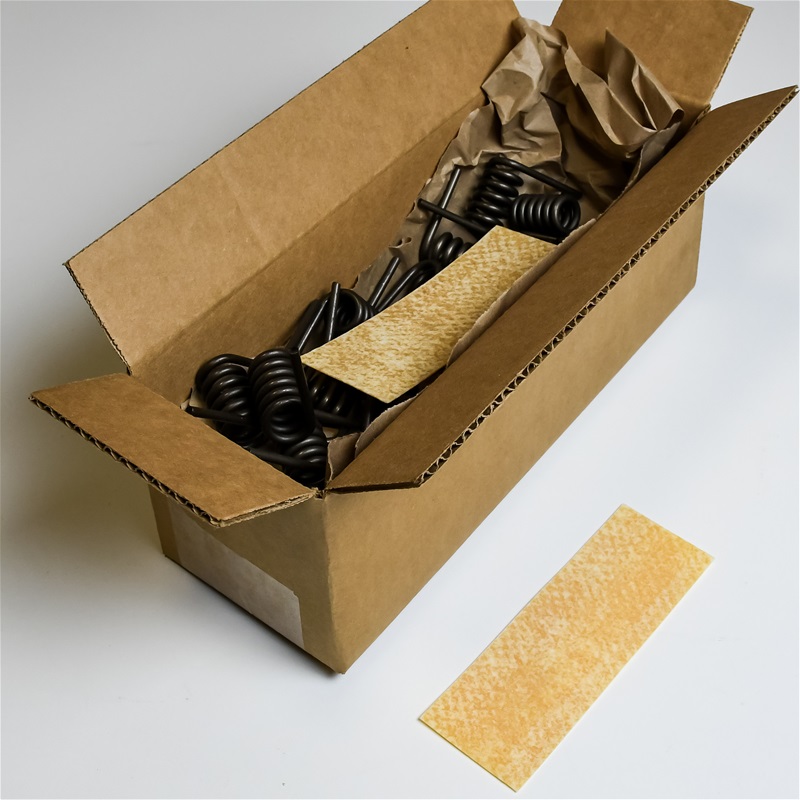
The 2″ × 3″ BioPad® is the smallest stock format of Cortec’s biobased VpCI® emitter pad: a non-woven PLA fabric impregnated with vapor-phase corrosion inhibitor, packed 1,000 to a carton for small boxes, bagged fasteners, kits and blister packs. It is 85% biobased and free of isocyanates, nitrates and chromates, and it does for a small package what the 2″ × 6″ and 8″ × 8″ pads do for cartons and crates: the metal inside stays rust-free without oils, greases or desiccant packs.
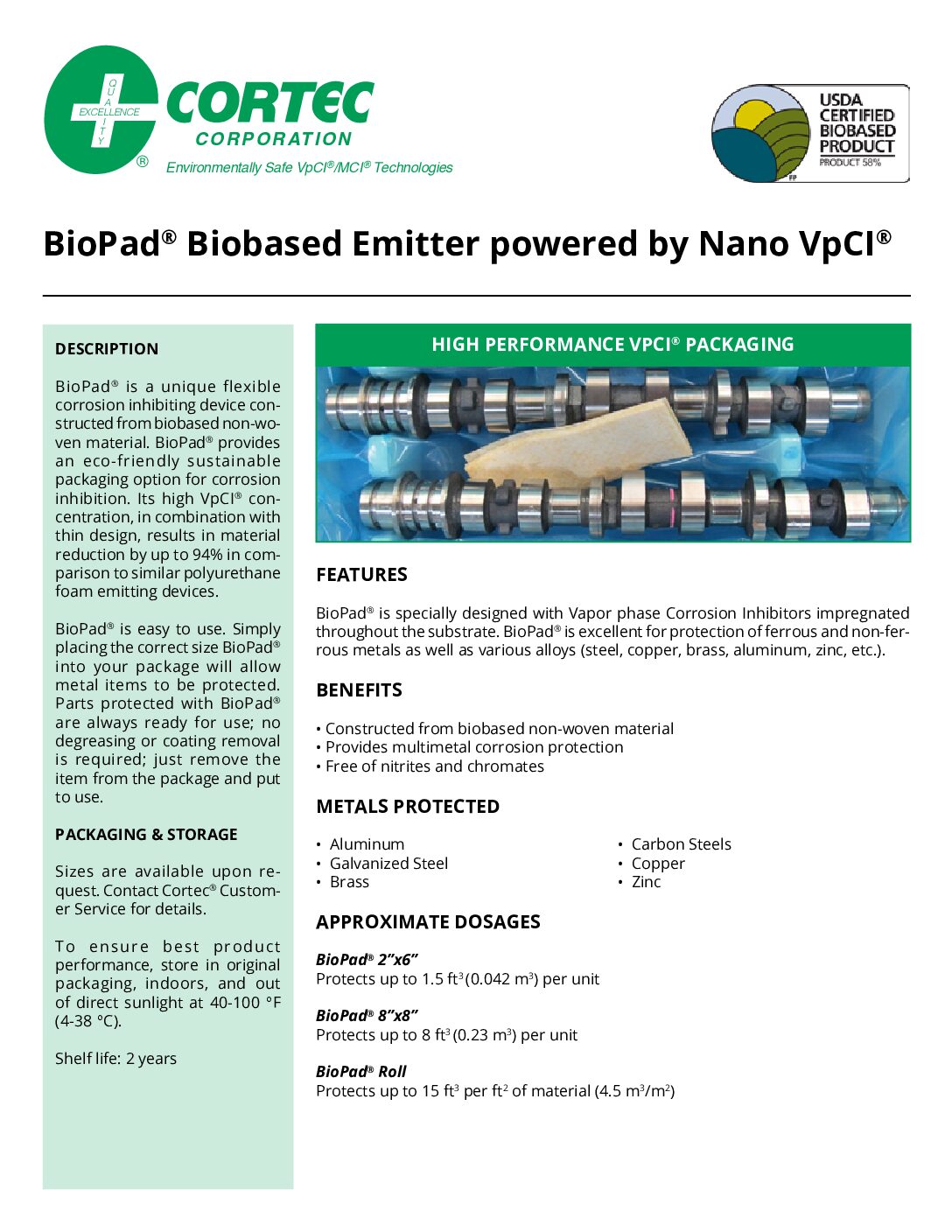
The substrate is an 85% biobased non-woven polylactic acid (PLA) fabric with VpCI impregnated through its whole thickness. Cortec puts a high VpCI concentration on a thin sheet, so a BioPad uses up to 94% less material than a polyurethane foam emitter of the same coverage, and it contains no isocyanates, nitrates or chromates. It protects aluminum, galvanized steel, brass, carbon steels, copper and zinc, so mixed-metal assemblies share one package. In the Cortec Product Consultation Guide BioPad is rated 1, enclosed: it works inside a sealed bag, box, crate, cover or shrink wrap, not on an open rack, where it replaces oil dips and desiccant-only packs. One caution from the data sheet: BioPad is not designed for direct contact with metal or painted surfaces, so on cosmetically critical items attach it to the packaging rather than laying it on the part.
Typical applications
- Enclosed packaging of machined, ground and stamped metal parts
- Boxed assemblies, kits and OEM service parts
- In-process storage racks and bins between operations (with VpCI-126 covers)
- Spare gears, motors and armatures in shrink-wrapped storage
- Multimetal components: steel with copper, brass, aluminum or zinc parts
- Export crates and shipping containers
- Inside VpCI-126 bags, MilCorr or VpCI-126 HP UV shrink wrap as the VpCI source
- Programs that need a biobased, isocyanate-free alternative to polyurethane foam emitters
How to use BioPad
- Start with clean, dry parts. Wash off coolant, fingerprints and salts and dry completely; the pad protects clean metal, it does not clean it.
- Size the dose. Cortec publishes dosages for the 2″ × 6″ pad (1.5 ft³), the 8″ × 8″ pad (8 ft³) and the roll (15 ft³ per ft²); the 2″ × 3″ pad is half a 2″ × 6″, so by Cortec’s custom-size rule (15 ft³ per square foot of material) treat it as the BioPad for boxes of roughly 0.6 cubic foot and below, the same job a 1″ VpCI-133/136 foam square does, and use one per small box or bag. For anything above about 1 ft³ use the 2″ × 6″ pad. Use two per box for aggressive marine or overseas conditions.
- Place it in the shared air space. Tape or staple the pad to the box lid, bag wall or crate side, or lay it on a separator, so it breathes the same air as the metal without touching a finished surface.
- Close the package. Seal the VpCI-126 bag or CorrCap, tape the carton, or shrink the MilCorr or VpCI-126 HP UV film. A sealed enclosure with minimal free air holds the VpCI concentration.
- Allow the void to saturate. The inhibitor condenses as a molecular layer on every metal surface, including bores and threads, within about a day. After shipping, keep the package closed for 24 hours after arrival so it acclimates before it is opened.
- Reopen and reclose as needed. The layer is self-replenishing while the pad is inside, so racks and bins can be worked from and re-covered. If a package is not airtight, add a fresh pad sooner.
- Return to service. Remove the part; no cleaning is required.
- Store unused pads sealed. Shelf life is 2 years; keep opened cartons resealed in plastic bags.
BioPad formats and approximate dosages (Cortec BioPad data sheet):
| Format | Protects | Packaging |
|---|---|---|
| BioPad 2″ × 3″ | Small boxes and kits; see sizing note | 1,000 per carton |
| BioPad 2″ × 6″ | Up to 1.5 ft³ (0.042 m³) per pad | 250 per carton |
| BioPad 8″ × 8″ | Up to 8 ft³ (0.23 m³) per pad | 250 per carton |
| BioPad roll, 57″ × 132′ | Up to 15 ft³ per ft² of material (0.45 m³/m²) | 1 roll |
Combining with other VpCI packaging
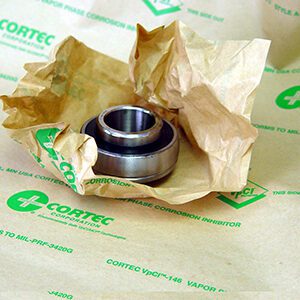
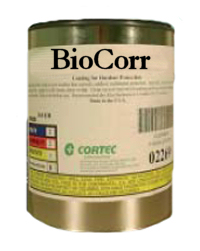
Cortec’s standard system is a VpCI barrier plus a pad in the void: a VpCI-126 Blue bag or 126 tubing for indoor storage and container shipments, MilCorr shrink film or VpCI-126 HP UV with a BioPad inside for outdoor storage (one of Cortec’s published outdoor-storage recipes), VpCI-146 paper interleaved between stacked parts, and Desicorr VpCI pouches where humidity is the driver. Parts should be clean and dry before they are packaged; see the Build-All and Magido aqueous parts washers, and where parts wait more than a day or two before packaging, VpCI-377 or BioCorr bridges the gap.
Where it fits in the Cortec line
BioPad covers the same volumes as the VpCI-130 series foams, 1.5 ft³ for 2″ × 6″ against VpCI-131 and 8 ft³ for 8″ × 8″ against VpCI-132, on a thinner biobased substrate; the foams add static dissipation to MIL-PRF-81705D, so choose foam where ESD matters and BioPad where a biobased, isocyanate-free or thinner insert matters. The 2″ × 3″ pad is the high-count format for small-parts packers; the 2″ × 6″ and 8″ × 8″ pads cover cartons and crates and the roll covers custom voids. BioBoard is the rigid board version for cartons; Cor-Pak tablets are the smallest dosing unit; VpCI-101 and VpCI-111 are the emitters for electrical cabinets. Browse the full Cortec VpCI line or the VpCI product selection guide.
Field notes
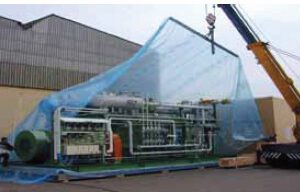
A Milwaukee, Wisconsin machine shop packed a spare marine-engine crankshaft for up to 10 years: VpCI-369 brushed into every surface and hole, the shaft laid on 10 mil VpCI-126 HP UV film in a long metal box with BioPads throughout, a second sheet over the bracing, and the film heat-shrink-taped with the upper layer overlapping the lower as a watershed. Fit for indoor or outdoor storage. (Cortec Case History #729)
A high-voltage switchgear maker in India had interrupters rust in export even inside vacuum-packed competitor VCI bags with local VCI foam. Six mil VpCI-126 bags with 8 by 8 inch BioPads and no vacuum passed the customer’s own VIA and razor-blade tests and three export trials to China; first order 2,000 pads and 150 custom film rolls. (Cortec Case History #680)
An Italian fabricator building 54 tanks and vessels for a U.S. Gulf Coast LNG project washed the internals with 5% VpCI-418 LM and, before shipment, installed BioPad at 1 m² per 4.5 m³ (11 ft² per 159 ft³) of internal volume. No corrosion through fabrication; residue-free removal at destination. (Cortec Case History #639)
Specifications
| Protects | Small boxes, bags and kits up to about 0.6 ft³ by Cortec’s custom-size rule of 15 ft³ per square foot of material; Cortec rates the 2″ × 6″ pad at 1.5 ft³ |
|---|---|
| Pad size | 2″ × 3″ |
| Construction | 85% biobased non-woven polylactic acid (PLA), VpCI impregnated throughout |
| Metals | Aluminum, brass, copper, galvanized steel, zinc and carbon steels |
| Composition | Free of nitrates and chromates; contains no isocyanates |
| Material reduction | Up to 94% less material than a polyurethane foam emitter of equal coverage |
| Consultation guide rating | 1 – enclosed (sealed bag, box, crate, cover or shrink wrap) |
| Important | Not designed for direct contact with metal or painted surfaces — attach to packaging for cosmetically critical items |
| Removal | Remove the part; no cleaning required |
| Shelf life | 2 years; store in original packaging at 40–100 °F (4–38 °C) and keep unused pads sealed in plastic bags |
| Size | 2″ × 3″, 1,000 pads per carton |
| Shipping weight | 6 lb (2.7 kg) |
| Availability | In stock |
| Cortec product number | 10508935 |
Solvent Recycling Systems is an authorized Cortec® distributor. See the full Cortec VpCI line, browse the VpCI product selection guide, or contact us for volume pricing and lead times.